
Your collagen didn't just drop after menopause. Something stopped it from ever coming back.
Placenta extract has been an approved medicine in Japan since the 1950s, prescribed by doctors ever since. In the 80s it was approved for menopause — hot flashes, sleep, mood. Then, in one of those trials on menopausal women, their skin changed.5 Nobody had been studying skin.
of your skin's collagen is lost in the first five years after menopause.1
You already know the collagen dropped.
Estrogen falls, collagen falls with it. You've read that a hundred times. You've probably bought the retinol, the peptides, the collagen powder.
What nobody told you is that you can get it back.
Because the cells that make collagen didn't disappear. Most of them are still there, healthy, and able to build. They just stopped — because the signal that used to tell them to build stopped the day your estrogen plummeted.
Two words you'll see a lot
Collagen is the scaffolding that holds your skin firm — a protein mesh just under the surface. Fibroblasts are the cells that make it. When there's less of it, skin loses its bounce. When what's left goes stiff, skin loses its softness. Everything below is about the cells, and the signal that tells them to build.
After menopause, two things happen to your fibroblasts. Some turn into zombies. The rest stop getting the order to build.
1. Some turn into zombies
After menopause, a growing share of your fibroblasts go into what scientists call senescence — zombie mode. The cell hasn't died. It's still sitting there in your skin. But it has stopped working for good: it won't recover, and it doesn't leave on its own. It has to be cleared out.
A zombie fibroblast stops making collagen. Worse, it leaks inflammation into the skin around it — the same low-grade inflammation behind the joint aches and the stubborn belly fat. And that inflammation breaks down the collagen you still do have. It's a double blow.
2. The rest stop getting the order
Estrogen wasn't just holding your skin up. It was what sent your skin's repair signal. Every time your skin was damaged, it was estrogen that sent the order: clear out what's broken, rebuild what's missing.
When estrogen plummeted, that signal stopped. Zombie fibroblasts piled up, because nothing was clearing them out. And the healthy fibroblasts — still the majority, still able to build — never got the order, because the only thing that used to send it was gone.
Before menopause
After menopause
That's why the collagen structure never comes back. Not because your skin can't rebuild it — it can. Because the signal estrogen used to send has stopped, and nothing has replaced it.
Why everything you've tried couldn't get past the zombie fibroblasts
Retinol, peptides, collagen drinks
They try one of two things: pour collagen in from outside, or get your fibroblasts to make more. That boost hits every fibroblast alike — the healthy ones make a little more, the zombie ones can't respond at all. And the zombies are still there, still leaking inflammation, still breaking collagen down as fast as anything can add it. It's a bucket with a hole in it. Nothing you've tried clears the zombies out. Only the repair signal does that — and then gives the healthy fibroblasts the order to build. Nothing in a cream, a peptide or a powder sends that signal. Placenta extract does.
Microneedling and lasers
These work by wounding your skin to force the repair signal. At 30, that signal is strong — it works. At 55, the signal is barely there. So you're wounding skin that heals slowly, and hoping something changes.
Your body has already done this once.
It built brand-new skin, from scratch, in the nine months before you were born. The organ that ran that job — feeding, protecting and instructing every new cell — is the placenta. No other tissue in the body carries that set of instructions.
The original instructions
Placenta extract isn't one ingredient. It's the complete set of instructions your body used to build skin the first time — growth factors, peptides, amino acids, in the mix nature chose.
It heals wounds
Burns and hard-to-heal wounds have been treated with placenta tissue in hospitals for decades — about the worst state skin can be in. It doesn't patch what's there. It rebuilds the tissue properly, including the blood supply — the way skin was built in the first place.
Sending the same signal — after estrogen has dropped
Sends the repair signal
Placenta extract sends your skin the same “clear out and rebuild” signal estrogen used to send. That one signal does two jobs.
Clears the zombie fibroblasts
Job one: the zombie fibroblasts — stuck in zombie mode, leaking inflammation — get cleared out, the way they would be after a wound. Clear them out, and the inflammation they were causing goes with them.
Your skin builds again
Job two: the healthy fibroblasts — there all along, but blocked from any signal — finally get the order to make collagen, elastin and hyaluronic acid. It's exactly how it heals a wound — only your skin isn't in a worst-case scenario. It isn't cut or burnt. It has aged, and that's an easier job.
Four places it worked before your face
Wounds
The proof estrogen was the signal
Women heal wounds more slowly after menopause — and giving estrogen back speeds healing up. When researchers looked at why, it was the skin's repair signal — the same one — that estrogen had switched back on.3
Placenta extract does the same switch without the hormone. In a trial, wounds treated with it closed faster from day three than untreated wounds, with new blood vessels growing in.2 That's wounded, burnt skin — the worst case. Now think about skin that isn't wounded, just aged. Same switch.
Menopause
Where Frumosa began
In a menopause trial in Korea, women with hot flashes and broken sleep were given placenta extract to treat those symptoms. Skin wasn't supposed to be part of the study. Nobody had been studying what placenta extract could do for skin. But their skin changed — and the women said so.5
That's the moment Frumosa noticed — and asked why forty years of menopause medicine, refined since the 1980s, had never been applied to menopausal skin. Those forty years are what this formulation is built on.
The liver
The first use, and the proof of the mechanism
In Korea and Japan people take placenta for hangovers, because it's known to help the liver rebuild. That's not folklore. Placenta extract's first medical use, back in the 1950s, was for the liver. In Japan it's a standard prescribed treatment for cirrhosis, the scarred liver8 — the way insulin is the standard treatment for type 1 diabetes.
Doctors have known for seventy years that it works. What nobody knew was why. So in a recent study, researchers set out to find out. The answer: the repair signal had switched back on, and the zombie fibroblasts had been cleared out. The exact two things that stop in your skin after menopause. Same extract, same mechanism.6 For seventy years it had only ever been pointed at a different organ.
The mouth
The proof it loosens stiff collagen
Remember, collagen is the scaffolding. And old collagen isn't just less collagen. It's collagen that has gone stiff — hard, tangled, set in place. That's why aged skin feels tight and looks fixed, even when there's still collagen there.
Placenta extract does something to stiff collagen that nothing else does: it loosens it. In a trial on patients with a rare condition called oral submucous fibrosis, which turns the tissue inside the mouth hard and scarred — so stiff they struggle to open their mouths — placenta extract softened that collagen. By the end, they could open their mouths wider again.7 Same collagen, same stiffness, as the skin on your face.
Get Up To 52% Off Plus A Free Face Cleanser Today


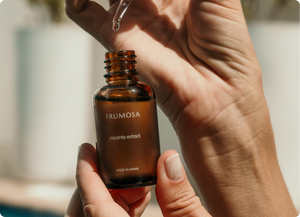
Neo-Placenta Age Repair Serum
The first skincare built to send menopausal skin the repair signal it lost — using the same placenta extract Japanese doctors have prescribed for seventy years.
- Sends the repair signal estrogen used to send
- Clears the zombie fibroblasts leaking inflammation into your skin
- Tells your fibroblasts to build collagen again
Most creams only cover up aging. Placenta extract actually reverses it at the source.
Instead of adding temporary moisture, placenta extract switches your skin’s repair system back on, just like it worked in your twenties. That’s why it’s been trusted in medicine for decades to regenerate damaged skin.
Now, with Frumosa’s advanced Japanese refinement, that same regenerative power is concentrated into a serum that delivers firmer, smoother, glowing skin that improves week after week.
Water, Placenta Extract, Phenoxyethanol. This minimal formula focuses on delivering pure placenta extract with only essential components - water as the base and phenoxyethanol as a gentle preservative. No unnecessary additives or fillers.
Apply 2-3 drops to clean skin morning and evening. Gently pat into face and neck, then follow with moisturizer. Use consistently for best results and avoid direct eye contact.
Extensively tested for purity and safety, meeting international pharmaceutical standards. Ethically sourced from Japanese thoroughbred horses with no animal harm involved. Suitable for all skin types including sensitive skin.
It was never your skin's fault.
Your fibroblasts didn't fail you. They were waiting for a signal that stopped coming the day your estrogen dropped. Every product you tried was stimulating cells that weren't listening.
This is the first one that sends the signal — with the one thing in the body that already knows how to build skin.
Sources
1. [VERIFY] Brincat M et al. Skin collagen changes in postmenopausal women receiving different regimens of estrogen therapy. Obstet. Gynecol. 1987.
2. Hong JW et al. The effect of human placenta extract in a wound healing model. Ann. Plast. Surg. 2010;65(1):96–100.
3. [VERIFY] Ashcroft GS et al. Estrogen accelerates cutaneous wound healing associated with an increase in TGF-β1 levels. Nat. Med. 1997; and follow-up studies 1999.
4. Karasawa Y et al. Clinical treatment test of Melsmon on menopausal disorder. Med. Treat. 1981;9(3):1–10.
5. Kovalenko II, Atalyan AV. The experience of using the placenta hydrolyzate in women with climacteric syndrome. Gynecology 2016;18(5):20–25. Kim S et al. Medicina 2023;59(8):1382.
6. Ishikawa N et al. Human placental extract improves liver cirrhosis in mice with regulation of macrophages and senescent cells. Regen. Ther. 2025;28:509–516.
7. Reddy CN et al. Indian J. Otolaryngol. Head Neck Surg. 2022;74:1996–2001. Ek J et al. 2023;75(4):3530–3534.
8. Alimu Y, Yamamoto T, Nakahata Y. Biological effects of human placental extracts. Front. Pharmacol. 2025;16:1707890.